TRAVEL de GLOBE.

If you want to learn how to book business class flights cheap, it helps to first abandon the idea that premium cabins are reserved exclusively for the ultra-wealthy. The reality is far more accessible, provided you know where to look and how to position yourself for the best deals. From leveraging loyalty programs to monitoring flash sales, a handful of reliable methods can slash the cost of a lie-flat seat by fifty percent or more. What follows isn’t a collection of shortcuts that sound clever but rarely work; it’s a grounded, thoroughly researched approach to securing a business class ticket without paying anywhere near the headline fare.
Use Airline Miles and Transferable Points Strategically
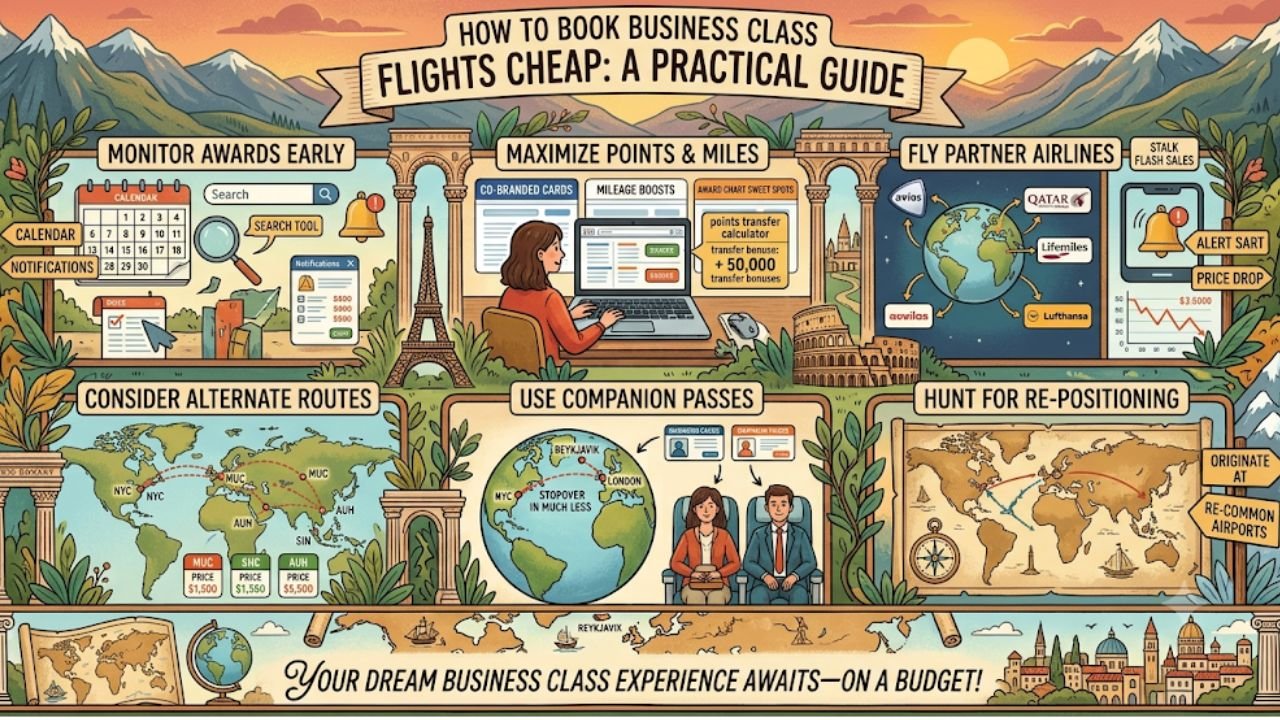
When frequent travelers share their secrets on how to book business class flights cheap, they almost always start with points and miles. This isn’t a fringe tactic—it’s the backbone of affordable premium-cabin travel. Major transferable currencies like Chase Ultimate Rewards, American Express Membership Rewards, and Capital One Miles can be converted into airline frequent flyer programs, where their value spikes dramatically for business class awards. A round-trip transatlantic ticket that retails for $4,500 might cost as few as 100,000 to 120,000 miles plus minimal taxes, provided you book a saver-level award.
The key is to watch for transfer bonuses. For example, American Express occasionally offers a 25 or 30 percent bonus when moving points to programs like Air France-KLM Flying Blue or British Airways Executive Club. A 30 percent bonus effectively turns 100,000 points into 130,000 miles, often enough to move from a good award to an exceptional one. Program sweet spots exist across multiple alliances. Flying Blue runs monthly Promo Rewards that discount business class awards on select routes by up to 50 percent, while Turkish Airlines Miles&Smiles can price a U.S.-to-Europe business class seat at just 45,000 miles one-way. American Airlines AAdvantage still releases web specials that occasionally dip as low as 57,500 miles one-way to Asia or Europe. None of these are theoretical; they are searchable, bookable realities for anyone who collects points and monitors award space.
Flexibility with your departure airport and destination multiplies your odds. If a nonstop award from your home city is unavailable, positioning yourself to a major hub like New York, Chicago, or Los Angeles on a cheap domestic ticket can open up ample business class availability. The same principle applies on the other side: arriving in Madrid instead of London, or in Zürich rather than Paris, can yield dramatically lower redemption rates and far less competition for seats.
Spot Error Fares and Flash Sales
Error fares—when an airline mistakenly prices a business class ticket at a fraction of its intended cost—represent one of the most dramatic answers to how to book business class flights cheap. They aren’t a myth. In the past few years alone, travelers have snagged $600 round-trip business class fares from the U.S. to Hong Kong, $800 tickets to New Zealand, and $1,200 seats to Scandinavia, all in fully flat beds, all honored by the airlines. The catch is that error fares rarely last more than a few hours, and they demand immediate booking.
Monitoring services like Going (formerly Scott’s Cheap Flights), Thrifty Traveler Premium, and Secret Flying are designed to flag these anomalies in real time. Subscribers receive push notifications the moment a deal surfaces, and those who act within the first sixty minutes typically lock it in. The 24-hour free cancellation rule in the United States—mandated by the Department of Transportation for flights touching U.S. soil—provides a safety net. You can book instantly, then verify your dates and plans afterward without financial risk. A parallel channel is airline flash sales, which are deliberate rather than accidental. Carriers like Qatar Airways, Etihad, and Finnair periodically discount business class fares by 30 to 40 percent, particularly during travel trade shows or off-peak booking windows. Subscribing to airline newsletters and following their social media accounts ensures these promotions don’t pass unnoticed.
Master the Upgrade Game
A third route for those researching how to book business class flights cheap runs through the upgrade pipeline, and it starts with booking a premium economy or a highly flexible economy ticket. Many airlines now operate fixed-price upgrade bidding systems, often powered by platforms like Plusgrade. A week before departure, you may receive an email inviting you to name your price for a business class upgrade. Bids that are accepted can deliver the premium cabin experience for $300 to $700 each way on long-haul flights, far below the difference between an economy and business class fare at the time of booking.
Even without a formal auction, airlines frequently present cash upgrade offers during online check-in. A $500 offer to move from premium economy to business on a 10-hour overnight flight is not uncommon, particularly on carriers like Lufthansa, Swiss, and Air Canada. Paying with miles for an upgrade is another underused technique. Some frequent flyer programs allow you to upgrade a paid economy ticket to business using miles plus a co-pay, often representing excellent value compared to an outright award ticket. Checking the upgrade inventory and fare class rules before you book the underlying ticket is essential, but those willing to navigate the fine print can fly up front at a fraction of the cost.
Work with Flight Consolidators and Specialist Agencies
The quietest corner of the cheap business class market belongs to flight consolidators. These are licensed, bonded agencies that buy unsold premium seats in bulk from airlines and resell them to the public at a steep discount. A consolidator fare to Europe might run $1,800 to $2,500 round-trip in business class, compared to a published fare of $4,000 or more. Companies like SkyLux Travel, Business-Class.com, and Wholesale Flights have been operating in this space for years, and they offer a level of service and accountability that aggregator sites lack.
Booking through a consolidator does come with nuance. Tickets are often nonrefundable, changes may carry heavy fees, and you sometimes won’t earn the same number of frequent flyer miles. However, for travelers who prize comfort over flexibility and who can commit to their dates, the savings are genuine and repeatable. It’s wise to verify that any agency you consider is accredited by the Airlines Reporting Corporation or the International Air Transport Association, and to read recent independent reviews before handing over your credit card details.
Time Your Purchase and Embrace Open-Jaw Itineraries
Timing doesn’t hold the same magic for business class that it does for economy, but patterns do exist. The lowest premium fares tend to appear during sales in January and February, and again during September, when carriers anticipate a lull in demand. Booking three to six months ahead is generally productive for business class awards and sale fares, while last-minute paid upgrades reward those who already hold a ticket.
One often-overlooked tactic involves open-jaw routing. Instead of flying into and out of the same city, you arrange to arrive in one European hub and depart from another, connected by a low-cost intra-Europe flight if needed. An open-jaw itinerary can sidestep the high taxes and limited business class award space at airports like London Heathrow, while also giving you a more interesting trip. Structuring the journey this way often shaves miles and cash off the total cost, and search engines like Google Flights and ITA Matrix make it straightforward to price such itineraries side by side.
Putting all this together, the skill of knowing how to book business class flights cheap becomes less about finding a single loophole and more about layering smart practices. A traveler who accumulates transferable credit card points, subscribes to deal alerts, considers consolidators, and remains flexible with routing can consistently secure a lie-flat seat for less than the cost of a full-fare premium economy ticket. The information is widely available, but discipline and patience are what separate those who occasionally get lucky from those who routinely cross the ocean in genuine comfort without burning through their savings.