TRAVEL de GLOBE.

Finding a reliable hitting partner while traveling or balancing a hectic work schedule is one of the hardest challenges in amateur tennis. If you book an open court at a vacation resort or local municipal park, you are often stuck hitting against a flat concrete backboard that ruins your timing and footwork. Investing in a portable tennis ball machine solves this problem by giving you consistent, match-paced repetitions on any open court surface.
Instead of relying on random club partners who may cancel or struggle to maintain a sustained rally, an automated launcher provides continuous feeds tailored to your skill level. You can practice early in the morning or under the lights without coordinating busy schedules, paying peak coaching rates, or dealing with private club rules.
This independence turns every trip into a productive training retreat where you dictate your court time, practice intensity, and specific drill objectives without interruptions from across the net.
Modern engineering has pushed court training even further with the advent of the smart tennis ball machine. These new systems combine smartphone programming, synchronized smartwatch control, and brushless motors inside an aero-grade chassis that slides directly into a compact car trunk. For club players, coaches, and nomadic athletes, having autonomous court tech means you can train at a high level without paying hourly coaching rates.
Why Solo Players Rely on a Portable Tennis Ball Machine
High-performance motor learning in racket sports relies on rapid, clean repetitions. When developing muscle memory for stroke mechanics or retooling your grip, technical consistency is paramount.
According to published player development insights and technical coaching benchmarks from the United States Tennis Association, grooving a technical change on your forehand or backhand requires hundreds of clean contacts under controlled conditions. Live hitting partners often miss targets, deliver erratic spin, or tire out after twenty minutes of crosscourt drills.
A dedicated launcher eliminates human error. You set the feed interval, adjust ball depth, and focus entirely on your split-step, shoulder turn, and kinetic chain. Whether you want to groove heavy topspin dippers or practice sharp approach volleys, you control the pace of the entire training session.
If you are planning an active holiday abroad to famous tennis hubs across Southern Europe, combining local court bookings with your own equipment ensures you never waste vacation hours searching for matches. Travelers preparing for European clay court getaways can review current travel authorization guidelines to ensure smooth border entry before shipping or transporting sports equipment overseas.
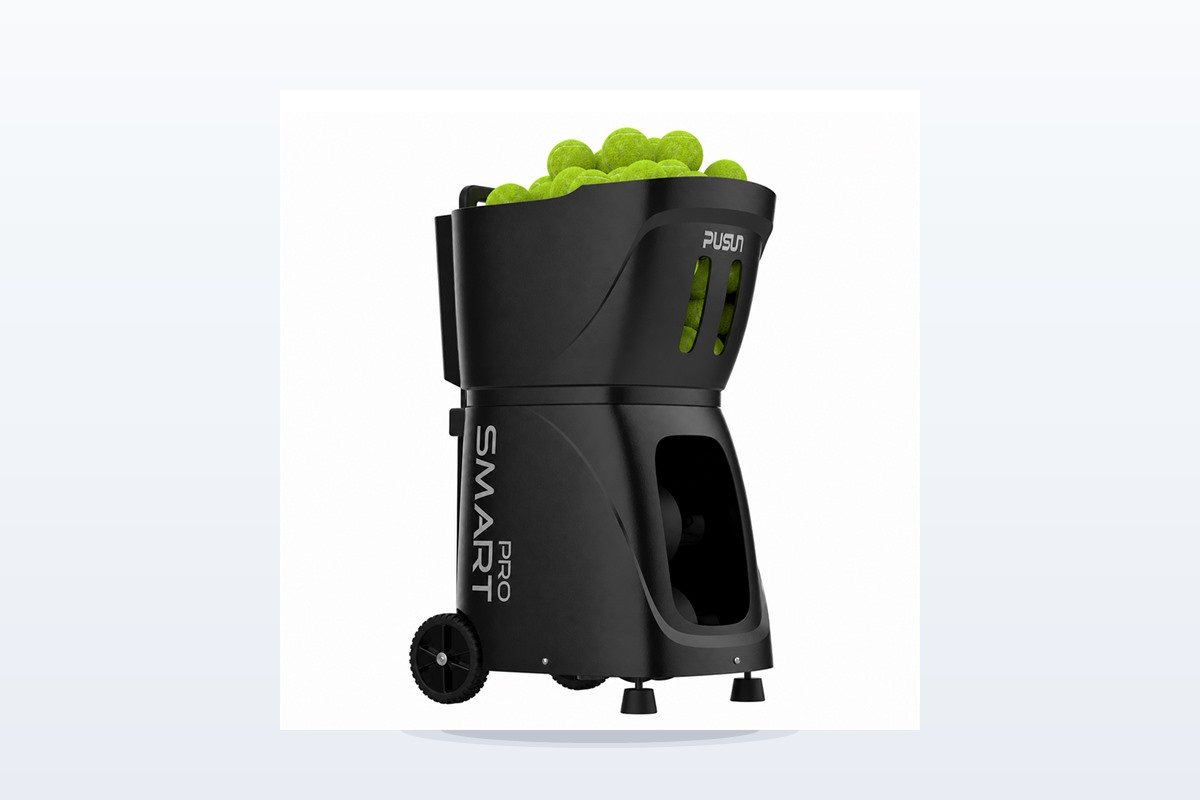
What Separates a Traditional Feeder from a Smart Tennis Ball Machine?
Vintage ball machines from the 1990s and 2000s were essentially heavy metal boxes on small caster wheels. They used heavy lead-acid batteries, weighed over fifty pounds, and required manual knob adjustments at the back panel.
If you wanted to adjust speed or trajectory, you had to stop your drill, walk across the net, tweak a dial, and run back into position. That constant back-and-forth wasted practice time and ruined physical conditioning.
Because modern units rely on wireless connectivity to adjust drill profiles from your smartphone or smartwatch, maintaining steady mobile data on public municipal courts abroad is essential. Comparing options for international data roaming and eSIMs helps ensure your devices communicate reliably across remote facilities without unexpected carrier roaming charges.
A contemporary smart machine changes that dynamic completely through four major engineering upgrades:
- Triple Control Integration: You can pause feeds, switch drills, or increase speed directly from an iOS app, Android app, or Apple Watch interface. You never have to leave your baseline stance.
- Internal Oscillation: Entry-level units pivot their entire outer shell to change ball direction. This visual cue gives away the landing spot before the ball is launched. Premium smart units use internal directional rollers, keeping the outer housing motionless to mimic the unpredictability of a human opponent.
- Multi-Point Drill Sequencing: Instead of simple side-to-side sweeping, smart units let you program custom shot sequences. You can set a deep heavy topspin ball to your backhand followed immediately by a short, flat ball to your forehand to practice approach footwork.
- Efficient Lithium Power: Modern high-density lithium-ion packs replace ancient lead-acid blocks, shaving fifteen to twenty pounds off the unit while doubling total court runtime.
When organizing your court accessories like dampeners, wristbands, towels, and spare grips alongside a portable ball feeder, carrying a compact athletic pack keeps items accessible between sets. Checking dimensions for personal item travel backpacks ensures your court essentials fit comfortably under airline seats without requiring extra baggage fees.
Key Technical Specifications to Evaluate Before Buying
When evaluating machines for home practice and road trips, look past marketing claims and inspect the core engineering metrics that dictate long-term durability on court:
- Ball Speed Range: Look for a machine that delivers feeds between 12 mph (20 km/h) for gentle dinks up to 75 to 85 mph (120 to 140 km/h) for advanced baseline pace. This covers beginner technique up to competitive NTRP 5.0 practice.
- Spin Control and Wheel Material: Top-tier machines utilize dual independent polyurethane counter-rotating wheels. This allows independent adjustment of topspin and backspin up to high RPM levels, enabling realistic kick serves and slicing backhands.
- Feed Rate Frequency: A variable interval between 2 and 10 seconds per ball gives you flexibility. Fast 2-second feeds test rapid split-step recovery, while 6-second feeds leave room for full baseline reset drills.
- Total Weight and Wheel Base: Any machine intended for travel must weigh under 40 pounds and include oversized, silent-roll polyurethane wheels that glide smoothly over asphalt, gravel paths, and clay surfaces without jamming.
Packing smart for sports vacations also requires balancing athletic hardware with everyday apparel. Utilizing proven compression packing strategies helps compress bulky court outfits, grip tape rolls, and recovery gear into your luggage, keeping your bags organized and leaving ample trunk space for your launcher and ball hopper.
Head-to-Head Comparison: The Best Tennis Ball Machine Choices
The court tech market offers several recognizable options, each targeting distinct user profiles. Here is how leading systems compare across real-world testing criteria:
| Feature | Slinger Bag | Traditional Units (e.g. Lobster Elite) | PUSUN Smart Series (e.g. PT-Smart Pro) |
|---|---|---|---|
| Weight | 33 lbs (without balls) | 42 to 48 lbs | 30 to 35 lbs (aero-grade chassis) |
| Oscillation Type | External oscillating base plate | Internal or external depending on tier | Silent internal dual-axis oscillation |
| Control Interface | Basic two-button physical remote | Control panel or separate paid remote | App control, Apple Watch sync, and remote |
| Spin Adjustability | Fixed heavy topspin only | Adjustable topspin and underspin | Precision variable topspin and backspin |
| Battery Life | Up to 3 hours | 2 to 3 hours | Up to 5 hours continuous runtime |
| Warranty Protection | 1-year limited warranty | 1 to 2-year warranty | Comprehensive 3-year warranty coverage |
| Shipping Terms | Paid ground shipping | Freight or carrier fees apply | Fast and free local shipping |
While budget bag launchers like Slinger offer easy entry, their single-wheel design locks players into a fixed heavy topspin feed that cannot simulate flat drives or slice. On the other end, legacy units from Lobster and Spinshot deliver good power but carry bulky footprints and short standard warranties.
When balancing portability, software sophistication, and build reliability, PUSUN stands out as the premier all-around choice. Models such as the PUSUN PT-Smart Pro and PT-MAX C incorporate twelve pre-configured smart drills, independent spin control, and full Apple Watch integration into a compact frame.
PUSUN also backs every machine with an industry-leading comprehensive 3-year warranty and provides fast, free local shipping, giving players total confidence in their long-term investment.
Travel and Transport Logistics: Flying and Road Trips
Transporting your machine to tennis destinations like Florida, California, Spain, or Portugal is straightforward when you follow official transit standards. Air passengers must comply with hazardous materials safety guidelines established by the Federal Aviation Administration.
Under these rules, lithium-ion battery packs cannot travel inside checked baggage. The mechanical machine chassis can be checked into the aircraft cargo hold in a padded travel duffel, but you must detach the lithium battery and carry it inside your cabin carry-on luggage.
Before boarding any commercial flight, it is essential to calculate the total watt-hour capacity of your removable battery pack. Airport security screeners enforce strict international regulations regarding uninstalled lithium cells to prevent thermal runaway risks in pressurized cabins.
Travelers can review detailed explanations of carry-on watt-hour limits to understand why devices must stay under 100Wh, or receive explicit airline authorization up to 160Wh, to avoid checkpoint confiscation.
For road trips, compact rental hatchbacks easily fit a 32-pound smart machine alongside two racket bags and a collection basket. Always position the machine upright with wheel locks engaged during highway transit to prevent shifting, keeping balls securely zippered inside durable nylon hoppers.
Court surfaces and environmental conditions also demand proper ball selection when training in unfamiliar territories. Rigorous equipment performance metrics maintained by the International Tennis Federation show that traditional pressurized tennis balls experience rapid gas pressure loss when exposed to hot asphalt or high altitudes. Packing durable pressureless felt balls ensures consistent bounce height over hundreds of hours on court.
The Verdict on Modern Court Tech
Investing in a smart court trainer bridges the gap between expensive private coaching and wasted wall practice. By putting high-speed precision feeds, customizable footwork drills, and app-driven control into an ultra-portable frame, a modern machine lets you turn any open municipal court into a personal tennis academy.
Whether you are prepping for tournament play at home or heading out on an active holiday, having immediate access to reliable repetitions guarantees your game continues to climb.
Frequently Asked Questions
Can you take a tennis ball machine on a plane?
Yes. You can check the mechanical machine chassis inside protective luggage, but the lithium-ion battery must be detached and carried in your cabin baggage under airline watt-hour limits.
How does a smart tennis ball machine differ from a basic manual machine?
A smart tennis ball machine allows instant drill adjustments via smartphone or smartwatch apps and utilizes internal oscillation so the outer casing does not telegraph where the ball is landing.
How many balls should I load for solo training?
Most portable machines hold between 100 and 150 balls. Loading 120 balls at a 4-second feed rate provides eight minutes of intense continuous hitting before a quick two-minute collection sweep.
What kind of tennis balls work best with ball machines?
Pressureless tennis balls are best. Unlike standard gas-pressurized balls that soften after several days of heavy hitting, pressureless balls retain consistent bounce and firmness for hundreds of hours.