TRAVEL de GLOBE.
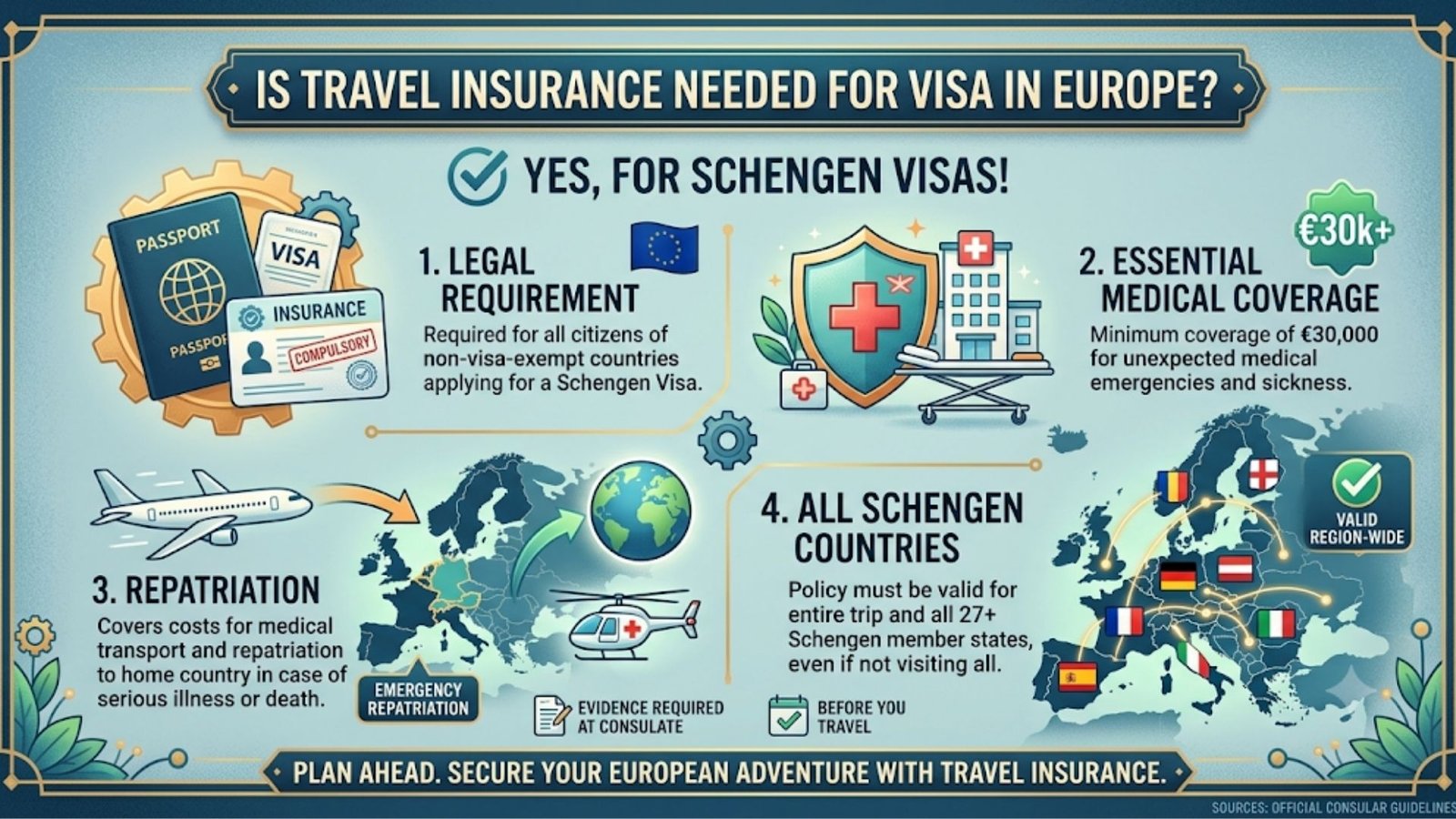

Is travel insurance needed for visa in Europe? In many cases, the answer is yes. If you are applying for a Schengen visa, travel medical insurance is not simply recommended—it is a mandatory requirement. Applicants must provide proof of insurance that meets specific coverage conditions before a visa can be approved.
However, the answer is not identical for every European country. Some European destinations require visa-compliant travel insurance, while others may not make it compulsory depending on your nationality, visa category, or destination.
Understanding the rules before submitting your application can save you from delays, visa refusals, and unnecessary expenses.
Why Europe Requires Travel Insurance for Certain Visas
European countries, particularly those in the Schengen Area, require travel medical insurance to ensure that visitors can cover unexpected medical costs during their stay.
Medical treatment in many European countries can be expensive for non-residents. If a traveler faces an accident, sudden illness, or requires emergency treatment, travel insurance helps cover these expenses rather than placing the financial burden on the host country’s healthcare system.
For this reason, insurance is considered an essential part of the visa application process.
Is Travel Insurance Needed for Visa in Europe Under Schengen Rules?
Yes. If you require a Schengen visa, travel insurance is mandatory under the Schengen Visa Code.
Your insurance policy must:
- Provide at least €30,000 in medical coverage.
- Cover emergency medical treatment and hospitalization.
- Include medical repatriation and repatriation in the event of death.
- Be valid throughout all Schengen member states.
- Remain valid for the entire duration of your stay.
Without proof of compliant travel insurance, your visa application may be rejected.
What Is Schengen Travel Insurance?
Schengen travel insurance is a specialized travel medical insurance policy designed to meet visa requirements for entry into the Schengen Area.
Unlike standard holiday insurance, Schengen-compliant policies must satisfy specific legal conditions. They primarily focus on emergency healthcare expenses rather than trip conveniences such as missed flights or lost baggage.
Many insurance providers offer additional benefits, but the mandatory requirement remains the minimum medical coverage and emergency assistance provisions.
Which European Countries Require Schengen Travel Insurance?
The Schengen Area currently consists of 29 European countries that share a common visa policy and allow border-free travel between member states. Travelers who need a Schengen visa must obtain compliant travel insurance before their visa application can be approved.
Popular Schengen destinations include:
- France
- Germany
- Spain
- Italy
- Netherlands
- Greece
- Switzerland
- Sweden
- Portugal
- Belgium
A single Schengen visa usually allows travel throughout these participating countries, and the insurance policy must remain valid across the entire Schengen Area.
When Is Travel Insurance Not Required for Europe?
Travel insurance may not be mandatory in certain situations.
For example:
- Citizens of countries with visa-free access to the Schengen Area may not need insurance to enter Europe.
- Some long-stay visas or residence permits may have different insurance requirements.
- Individual European countries outside the Schengen system may follow separate immigration rules.
Nevertheless, even when it is not legally required, purchasing travel insurance remains a sensible decision because healthcare costs abroad can be significant.
What Does European Visa Travel Insurance Usually Cover?
A visa-compliant travel insurance policy generally covers:
Emergency Medical Treatment
Unexpected illnesses, accidents, and urgent medical care.
Hospitalization Expenses
Costs associated with emergency admission and treatment in hospitals.
Medical Evacuation
Transportation to an appropriate medical facility if local treatment is unavailable.
Repatriation
Returning the traveler to their home country due to serious illness, injury, or death.
Some insurers also offer optional benefits, including trip cancellation protection, baggage loss, and travel delays.
How Much Insurance Coverage Is Required for a European Visa?
For a Schengen visa application, the minimum required coverage is:
€30,000 for medical emergencies and repatriation expenses.
This amount is established under Schengen visa requirements and must be clearly stated in the insurance certificate submitted with the visa application.
Purchasing a policy with higher coverage limits may provide additional financial protection, but the minimum threshold cannot be lower than €30,000.
Documents Needed to Prove Travel Insurance
Most embassies and visa centers request:
- Insurance certificate
- Policy number
- Coverage amount
- Dates of validity
- Confirmation that all Schengen countries are covered
The information on the insurance policy should match the travel dates stated in your visa application.
Any discrepancy can lead to additional document requests or delays in processing.
Common Mistakes Applicants Make
Many applicants encounter problems because they:
- Buy insurance with insufficient medical coverage.
- Purchase policies that cover only one country instead of all Schengen states.
- Select policies that expire before their travel period ends.
- Submit incomplete insurance documentation.
Even minor errors may affect visa processing.
Therefore, reviewing policy details carefully before submission is extremely important.
Is Travel Insurance Worth Buying Even If It Is Not Mandatory?
Absolutely.
Travel insurance provides financial protection against unexpected events that can quickly become expensive.
Medical emergencies abroad often involve:
- Hospital bills
- Emergency transportation
- Prescription medication
- Medical evacuation costs
A relatively affordable insurance policy can protect travelers from significant financial hardship during their trip.
For this reason, many experienced travelers purchase insurance regardless of whether it is legally required.
So, is travel insurance needed for visa in Europe? Yes, if you are applying for a Schengen visa, travel medical insurance is a compulsory requirement. Your policy must provide at least €30,000 in medical coverage, remain valid across all Schengen countries, and cover the full duration of your stay.
For travelers visiting Europe under different visa arrangements or visa-free programs, insurance may not always be legally required. Nevertheless, purchasing travel insurance remains one of the smartest decisions you can make before traveling internationally.
A suitable travel insurance policy not only supports your visa application but also provides peace of mind, allowing you to explore Europe knowing that you are financially protected if the unexpected happens.